

Commercial Snow Removal Contracts in Asheville
Signed before the first storm.
A commercial snow contract settles, before the season, when the plow comes, what gets cleared first, what gets salted and where the snow goes. M&S Land Management sets up seasonal, per-push and per-event agreements for HOAs, mountain communities with private roads, churches, offices, retail, short-term rental managers and property managers around Asheville and Western NC.
- Free on-site estimates
- Owner-run by McKinley
- Pre-season walk-through
How a snow contract is set up
Seasonal, per-push or per-event
There are three common ways to pay for snow work. A seasonal contract is one agreed fee for the winter, however many storms come. A per-push contract bills each plowing pass, so a long storm that needs three passes costs three times one. A per-event contract bills each storm as a unit, with the contract defining what counts as one event and how long it lasts. Salting is often billed per application on top of any of them.
Seasonal suits owners who want a fixed budget and no approvals mid-storm. In a light winter it can cost more than paying as you go. Per-push and per-event follow what actually falls, which suits a winter of two storms and stings in a winter of eight. In Western NC, where some winters bring little and others bring ice after ice, the right type is the one your budget handles better.
What goes in the contract
The trigger: the snow depth that starts plowing, and whether freezing rain or ice starts salting on its own. The route order: where the property falls on the route and which parts of it are done first. The scope: lots, drive lanes, private road, walks, entrances, steps and ramps, each named. Salting: which surfaces, what material, and whether refreeze visits are included. Hauling: whether piles get loaded out when there is no room to push, and where they go.
Then the site map. It marks where snow is pushed, where it must never go, and the edges, curbs, drains, culvert headwalls, islands and anything else a blade could hit under snow. The contract also says how damage is reported and how timing fits the property, such as clearing before Sunday services or before an office opens. Writing it all down keeps the first storm from turning into an argument.
HOAs and mountain communities with private roads
Many mountain communities around Asheville sit on private roads. Buncombe County maintains no roads, and NCDOT plows only what is on the state system, so the association or the neighbors are on their own. A contract for a private road names the full length from the state road to the last house, the steep pitches and switchbacks that get grit, the turnarounds, the mailbox area, any gate and the spot where the road meets the state road.
The association signs one agreement and pays one bill, instead of each owner hiring separately and the plow stopping at a property line. Grades on these roads usually matter more than depth, so the contract should cover ice and refreeze, not just plowing. The guide to private road repair in Western NC covers road maintenance agreements, which often decide who pays for snow as well.
Churches, offices, retail and rentals
Each kind of property needs a different start time. A church needs the lot, walks and steps clear before services, which often means work late Saturday or early Sunday. An office needs the lot open before the first car. Retail needs the entrance cleared and treated before opening and kept that way through the day. Property managers need one schedule across several sites, with the order written down so nobody has to call.
Short-term rental managers have a problem of their own: guests in rental cars arriving at a steep mountain drive they have never seen, often after dark. Clearing ahead of check-in and check-out days, gritting the steep pitch, treating the steps and keeping the turnaround open matter more than depth. Those properties are usually set up with steep driveway plowing and walk clearing on the same agreement.
Walk the site before it snows
Sign before the first storm. In the fall, McKinley walks the property with you while the ground is bare. Edges, drains, culvert ends, curbs, rocks and islands get staked so they can be found under snow. The site map is drawn and agreed, the push areas are picked and the route order is confirmed. A property that signs in the middle of the first storm skips all of that, and the blade finds the hazards the hard way.
For commercial sites in the Upstate around Spartanburg and Greer, the threat is usually an ice event more than snow, so those contracts center on salting and ice management for lots, entrances and walks. If you are comparing bids, the snow and ice contract guide lays out what to ask each contractor, how to line the quotes up and what to get in writing.
Snow Removal and Ice Control
Plowing, salting, hauling and walk clearing for homes, private roads and businesses around Asheville.
See the pageTalk to McKinley(828) 540-6856
Call or text the address and what needs clearing: a lot, a drive, walks or all three. McKinley sets the route and the terms with you before the first snow.
Call nowWhat that covers
- Seasonal contracts. One agreed fee for the winter, however many storms come.
- Per-push and per-event. Billed by plowing pass or by storm, as defined in writing.
- Salting and refreeze. Ice triggers, named surfaces and return visits.
- Walks and entrances. Sidewalks, steps and ramps listed as their own line.
- Snow hauling. Piles loaded out with the skid steer and dump truck.
- Site map and walk-through. Edges and hazards staked in the fall.
Snow Removal and Ice Control
Plowing, salting, hauling and walk clearing for homes, private roads and businesses around Asheville.
See the pageSnow serviceSalting and Ice Management
Pre-treating, salting and refreeze visits for ice storms, freezing rain and shaded mountain grades.
See the pageSnow serviceSidewalk and Entrance Clearing
Walks, entrances, steps and ramps cleared and treated so people get from the car to the door safely.
See the pageSnow serviceSnow Hauling
Snow piles loaded out with the skid steer and dump truck when a tight mountain lot has nowhere to push.
See the pageSnow serviceSnow Plowing
Lots, private roads, mountain community roads and long drives, plowed in an order set before the season.
See the pageSnow services in the contract
A contract can combine any of the snow services. Most start with snow plowing for lots and private roads and add salting, walks and hauling as the site needs them. The full list is on the snow removal and ice control page, with work across Asheville, Hendersonville, Weaverville, Black Mountain, Waynesville, Fletcher and Brevard.
Set up before the first storm.
You call
Call or text with the address, how steep the drive or road is and what needs clearing: lot, drive, walks or all of it.
McKinley walks it
He walks the property before the season, notes the grades, the shaded stretches and where the snow can go.
Terms in writing
Seasonal, per push or per event, the trigger, salt and walks are written down before anyone needs them.
Cleared when it falls
When the storm comes, the property is worked in the agreed order and treated where ice will form.
The machines and the crew.
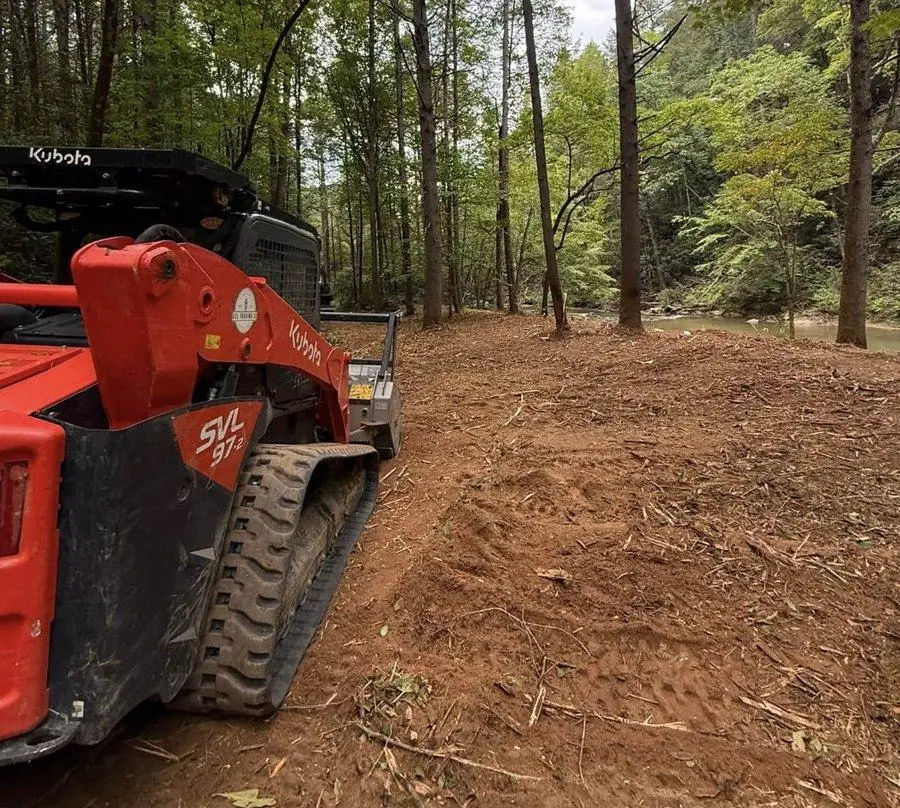
These are photographs from McKinley's actual jobs: the same equipment and the same crew that run the snow routes. See more recent work.
Questions people ask
Not seeing yours? Call (828) 540-6856 and ask McKinley, or read the guides.
What is the difference between per-push and per-event?
Per-push bills each plowing pass. A storm that needs three passes is billed as three. Per-event bills the whole storm as one unit, however many passes it takes, so the contract has to define what an event is: when it starts, when it ends, and whether a storm that stops and starts again counts once or twice. Salting is often billed per application under either one.
What happens with a seasonal contract in a light winter?
You pay the agreed fee either way. That is the trade: a fixed budget and no approvals, in exchange for paying the same in a quiet winter as in a busy one. Some seasonal contracts cap the number of events covered and bill extra above it. Read that part carefully, and compare it with what per-event would have cost over a few recent winters.
Who signs the contract for a private road?
Usually the HOA or road association, or one neighbor acting for the others under a written agreement. One signer and one bill keeps it simple. If there is no association, the neighbors should agree in writing how the cost is split before the contract is signed, so nobody is left holding the bill for the whole road.
Is salting included in a snow contract?
Only if the contract says so. Many contracts list salting separately, billed per application, because ice events in Western NC do not line up with snow depth. Make sure the contract names which surfaces get treated, whether refreeze visits are included, and what starts salting when there is no snow at all, such as freezing rain.
Why does a snow contract need a site map?
Because snow hides everything a blade can hit. The site map shows where snow goes, where it must never go, and every hazard under it: curbs, drains, culvert ends, islands, rocks, steps and drop-offs. It is agreed at the pre-season walk-through and kept with the contract, so everyone works from the same sheet in the dark at the start of a storm.
Other work he takes on
Most jobs end up being two or three of these at once, and they get quoted together.
Snow removal in other towns
Gravel Driveways
A new drive cut into the hill, based in lifts and crowned to shed water.
Learn moreDriveway Repair & Grading
Washouts, ruts and potholes fixed at the cause, not just regraded.
Learn moreDrainage & Erosion Control
French drains, catch basins, culverts and riprap so the property sheds water.
Learn moreRetaining Walls
Block, boulder and riprap walls that hold a cut bank up.
Learn moreLand Clearing
Lots, building sites and overgrown acreage cleared, stumps and root mat out.
Learn moreHouse Pads & Site Prep
Pads cut, filled and compacted on ground that started at anything but level.
Learn moreFree snow contract estimate.
The address, how steep the drive or road is, and what needs clearing. McKinley walks it before the season and gives you the terms in writing.
- Free on-site estimates across WNC and the Upstate
- Residential drives and commercial lots
- Seasonal, per push or per event, set up before the first storm
Snow removal where you are
Each town has its own page: what winter does there, what gets plowed and how the contracts are set up.
Set up your snow contract now.
Call McKinley at (828) 540-6856 to walk the site and get a contract in place before the first storm.