

What a gravel driveway costs in Western North Carolina comes down to five things: how long and wide it is, how steep the ground is, how much drainage it needs, how much base the soil needs and how far the stone has to be hauled. Two drives of the same length can cost very different amounts, which is why we measure on site and give you one number for the whole job.
You will not find a price per foot in this guide. Stone and fuel prices move, and a number that fits a short flat drive in a valley is wrong for a long climb up a cove. What this guide does is explain each thing that moves the price, so you can tell why two quotes differ and what a low quote has left out.
M&S Land Management builds gravel driveways across Buncombe, Henderson, Haywood and Transylvania counties. Estimates are free and on site.
Length and width
Length is the obvious one. Width matters as much, and it is the one people forget. A drive wide enough for a delivery truck uses a lot more stone than one cut for a car. Turnarounds and passing places add area too.
If a fire engine or a concrete truck will ever need to use the drive, it has to be sized for that from the start.
Grade: what a gravel driveway costs on a slope
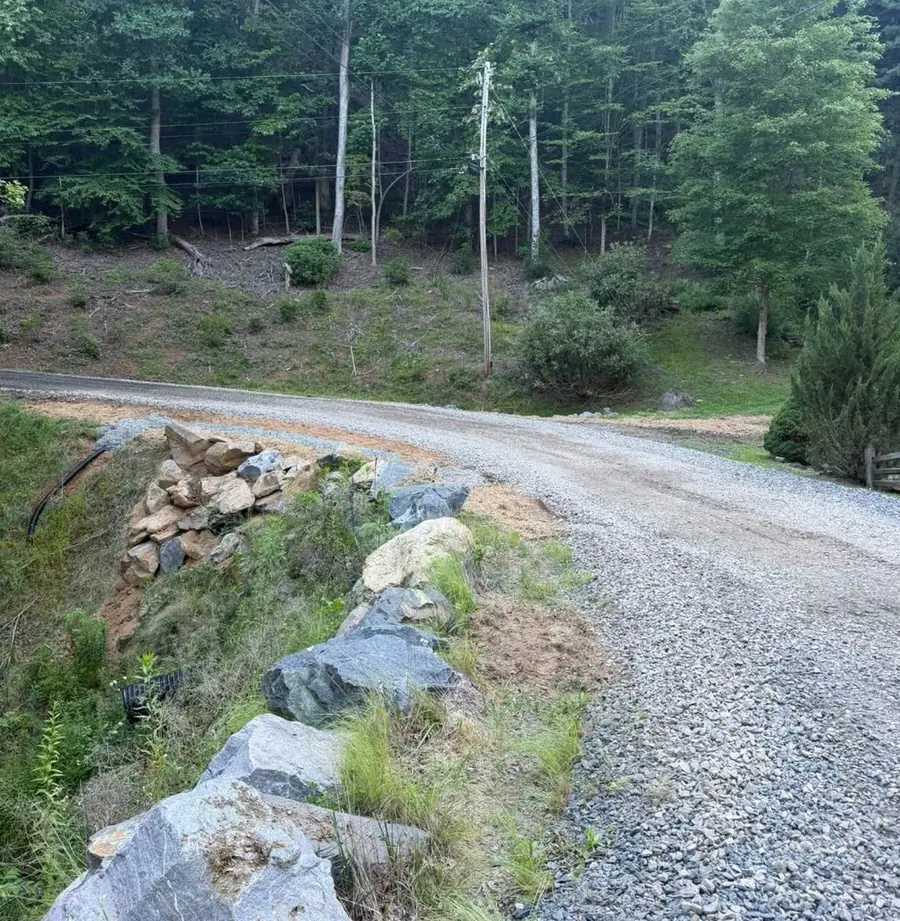
This is what separates the mountains from flat country. On a slope the drive has to be cut into the hillside, so the uphill side is bank and the downhill side is supported. Cutting takes machine time, and the steeper the ground, the more of it there is.
A cut also leaves a bank. Some banks stand on their own. Others need riprap or a retaining wall, and that is priced on top of the driveway.
Drainage: the part that decides how long it lasts
In the mountains, water does more damage to a driveway than traffic does. Expect a crown, a ditch line on the uphill side and a culvert wherever water crosses. Each culvert adds pipe, digging and stone at the outlet, so a drive that crosses two wet draws costs more than one that crosses none.
Rainfall matters too. Transylvania County, around Brevard, is the wettest ground we work on, and drainage there is sized up to match. A quote that is lower because the drainage was left out is the expensive one. See drainage and erosion control.
Base: what is under the stone
Stone laid on soft ground sinks into it. The base is built in layers, called lifts. Larger stone goes at the bottom, and each layer is compacted before the next goes on.
Firm ground on a ridge needs less base. A wet cove bottom or a filled area needs more. You cannot see this from the road, which is one reason a price given over the phone is a guess.
Haul distance and access
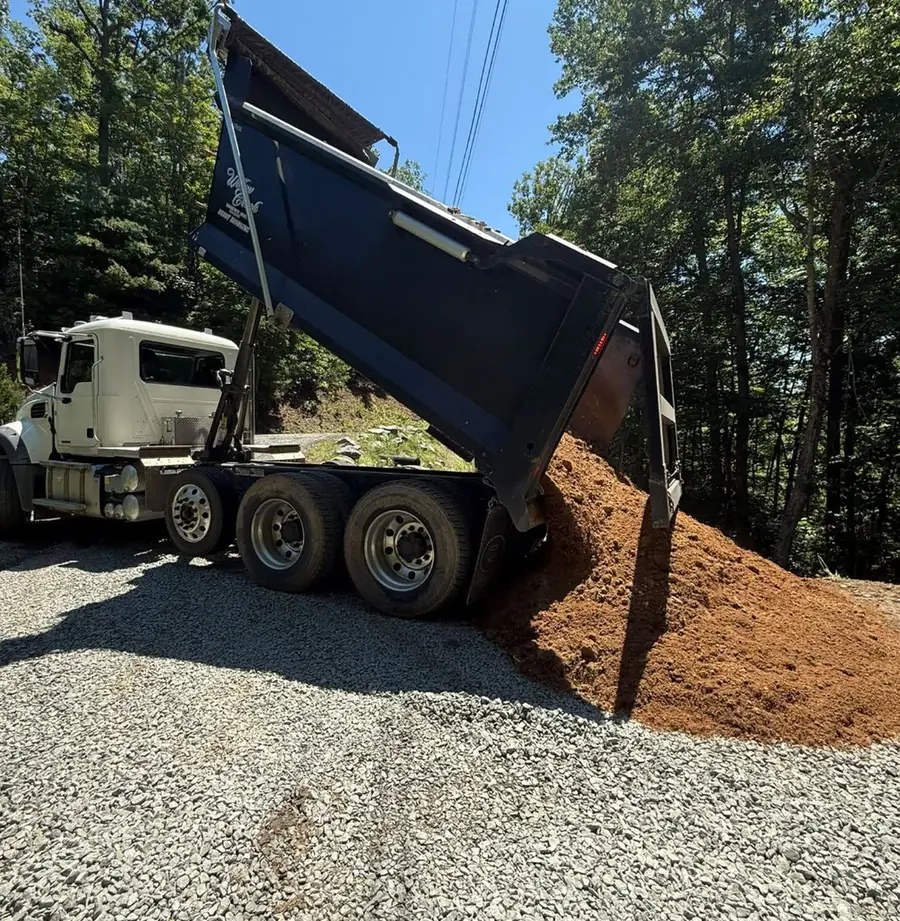
Stone is heavy, and part of its price is how far the truck has to carry it. A property at the end of a long mountain road pays more for the same stone than one close to town.
Access counts as well. If a full-size dump truck cannot get up the route yet, the stone has to come in smaller loads.
Clearing, and what is already there
A drive through open pasture starts at the cut. A drive through woods starts with trees, stumps and root mat coming out along the route. That is land clearing, and it is priced with the job.
Permits and the road entrance
Where a new driveway meets a state-maintained road, the connection has to be approved by NCDOT, and NCDOT has its own requirements for the pipe at the entrance. Larger projects can also need an erosion control permit. North Carolina requires an approved plan once a project disturbs an acre or more, and some counties, Buncombe among them, run their own programs with their own rules. Check with the NCDOT district office and your county before work starts.
Repair or rebuild
Not every bad driveway needs replacing. If the base is sound and the problem is the shape, regrading and re-crowning costs far less than a new build.
If the drive washes out every year, adding stone is the cheap option that costs the most over time. We will tell you which one you have.
How to get a real number
Send us the address, a rough length, and photos of the steepest part and the wettest part. Then we come out, walk it and measure. The number you get covers the whole job. Ask for a free estimate.
Quick Answers
Why is there no price per foot for a gravel driveway?
Because length is only one of the things that set the price. Grade, drainage, base and haul distance can each change the cost of the same length of drive. A per-foot rate given over the phone usually changes on site. We measure first and give one number.
Is a gravel driveway cheaper on flat ground than on a slope?
Usually, yes. A drive on a slope has to be cut into the hill, needs more drainage work and may leave a bank that needs stone or a wall. Flat ground skips most of that, though soft flat ground can need more base.
Does adding more gravel fix a driveway that washes out?
Only for a few months. A drive washes out because water runs down the surface instead of off it. The lasting fix is the crown, the ditch line and the culverts, and then the stone.
Is the estimate free?
Yes. Estimates are free and on site across Western North Carolina and the Upstate.
Related
- Gravel Driveway Installation
- Driveway Repair & Grading
- Culvert Installation
- Guide: how to prepare land for building a home
- Asheville service area
- All service areas
See our gravel driveway installation service or call (828) 540-6856.